
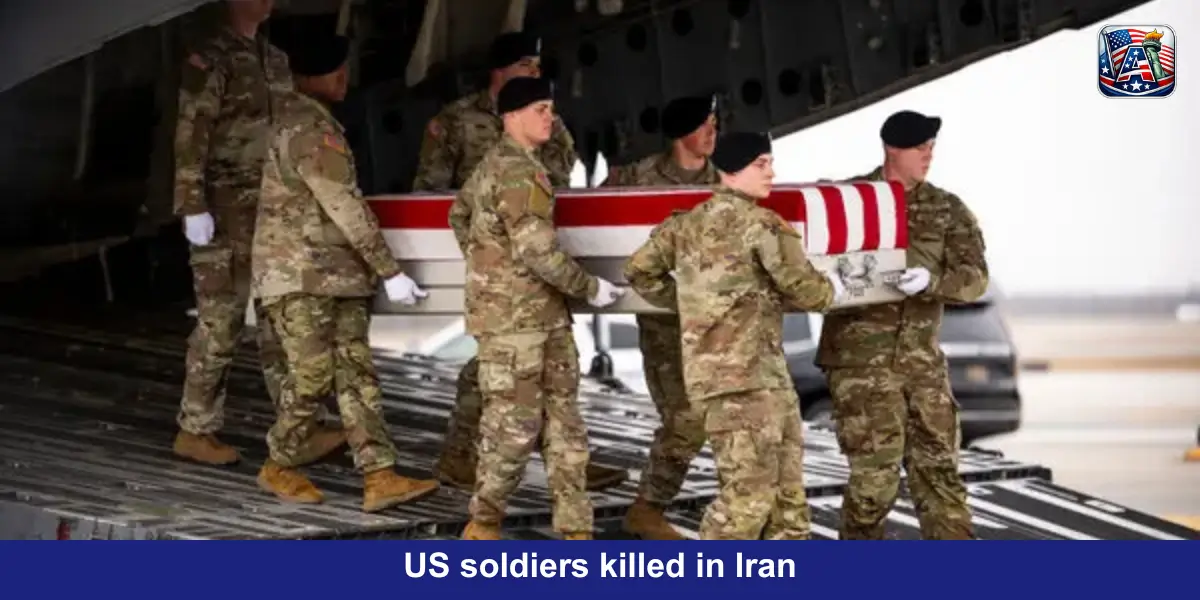
US soldiers killed in Iran
The US-Iran war in 2026 is one of the largest military escalations in decades. In late February, tensions started to rise, but they swiftly evolved into large-scale military activities in many Middle Eastern nations. By the middle of March, more than 200 American soldiers had been injured and 13 had died.
These losses are more than simply numbers. They stand for young students, dads, mothers, and professional warriors whose lives were cut short too soon. Some of the dead were a mother of two from Minnesota, a college student from Iowa, and members of the Air National Guard who were conducting critical work in Iraq. Everyone has a tale of bravery, commitment, and selflessness, and everyone in the country, in their families, and in their communities is sad.
This page contains a complete, accurate history of the Iran War, including a timeline, first-person accounts of troops who died, information about injuries and deaths, the military units engaged, the war’s strategic importance, and the war’s repercussions on people and politicians throughout the world.
How the War in Iran Started in 2026
The US and Iran’s relationship had been becoming terrible for years, and it became worse in February 2026. The situation is unstable because of disagreements about military presence, regional dominance, and proxy wars. There were a lot more assaults and military drills in the first several months of 2026. This led to genuine combat activities, which was different from the preceding several years when things were mostly peaceful.
This war is distinct from most others since it involves many countries, such Kuwait, Iraq, and Saudi Arabia, instead of just one battleground. The U.S. military’s bases in these nations have become the main targets of drone strikes, missile assaults, and other activities by proxy organisations.
This fight is a wonderful example of how wars are fought today. Military losses don’t only happen on the front lines. They also happen to pilots, logistics workers, and support groups that are far away from the adversary. This makes it apparent how dangerous the situation is for any American soldier in the area.
A timeline of important deaths in the U.S. military
Drone Attack in Kuwait on March 1, 2026
On March 1, the first important thing that happened was a drone attack on a U.S. Army Reserve unit in Kuwait. Six individuals from the 103rd Sustainment Command, which was in charge of logistics, food, and supply support, killed.
This attack not only killed individuals immediately away, but it also highlighted how fragile even well-protected military outposts might be. The U.S. military has to deal with the loss of these very skilled warriors, which is both a personal sorrow and a duty.
Attacks on the Prince Sultan Air Base in Saudi Arabia from March 1 to 8, 2026
On the same day, a separate occurrence at Saudi Arabia’s Prince Sultan Air Base hurt a lot of soldiers. On March 8, Sgt. Benjamin N. Pennington of the Army’s 1st Space Battalion died from his injuries. This highlights how hard it can be to get medical attention in combat zones and how serious wounds may be, which can lead to deaths days after an attack.
On March 12, 2026, the KC-135 jets crashed in Iraq.
A U.S. KC-135 aerial refuelling jet crashed in western Iraq on March 12 while it was supporting current operations. This was the third time this had happened. The aircrew’s six members all died. These deaths highlight how risky it is to undertake logistics and support work in war zones, even if they weren’t directly caused by enemy fire.
Profiles of the Soldiers Who Died
Every one of the 13 confirmed dead had a tale of bravery, loyalty, and putting others first. Their lives and experiences illustrate that there are different ways to serve your nation.
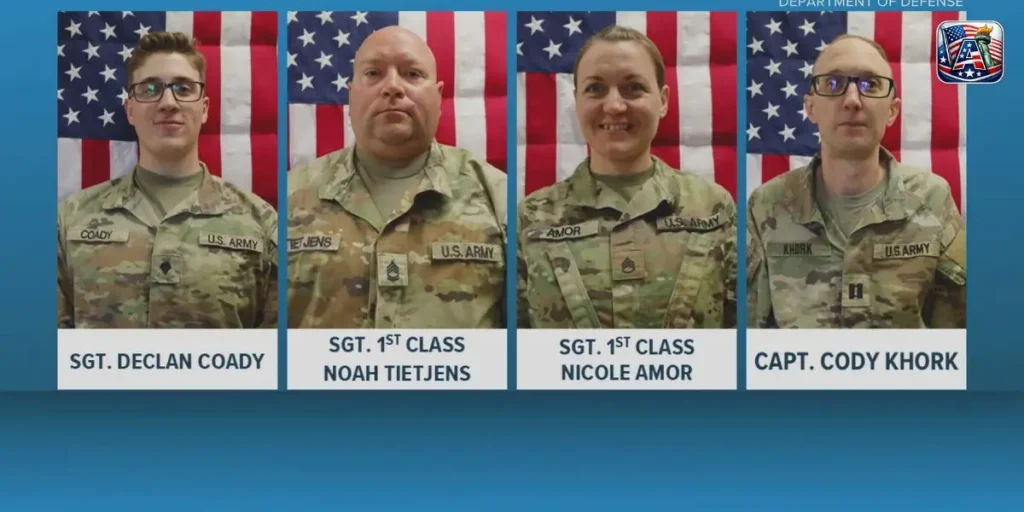
Captain Cody A. Khork is 35 years old and resides in Winter Haven, Florida.
Khork was an officer in the Army Reserve and served for the 103rd Sustainment Command. He has travelled to Poland, Guantanamo Bay, and Saudi Arabia earlier as well. He got a lot of awards, such as the Army Commendation Medal, the Meritorious Service Medal, and the Military Outstanding Volunteer Service Medal. People remembered him for a long time, and friends claimed he was a really good person who always helped others.
Sgt. 1st Class Nicole M. Amor, 39, is from Minnesota.
Amor was going to come home in a few days when she was slain. She had two kids. She served in Kuwait and Iraq before joining the National Guard and Army Reserve in 2005. People thought of her as a dedicated soldier and a loving mother. She was also known for her love of rollerblading, gardening, and being with her family.
Sgt. Declan J. Coady, 20, is from West Des Moines, Iowa.
Coady was on his first deployment while going to Drake University to study about cybersecurity at the same time. After he died, he was made a sergeant. His classmates and professors liked him even though he was young since he was talented and worked hard. His family stated he was clever, polite, and devoted to serving his nation with his unit.
Maj. Jeffrey R. O’Brien, 45, lives in Waukee, Iowa.
O’Brien was a computer science graduate, a loving mom, and a member of the Signal Corps. People knew him for helping others, putting them first, and staying in touch with his small-town Iowa background.
Robert M. Marzan, who is 54 years old, is a Chief Warrant Officer 3 in Sacramento, California.
After more than 30 years in the Army, Marzan was getting ready for his last tour. His family believes he was a devoted soldier who stayed that way till the end, a loving husband and father, and a lifelong servant of his nation.
Sgt. Benjamin N. Pennington is 26 years old and resides in Glendale, Kentucky.
Pennington died from injuries he sustained while serving with the 1st Space Brigade, 1st Space Battalion at Prince Sultan Air Base. He was given the rank of staff sergeant after he died because he was brave, professional, and eager to serve even when circumstances were hard.
Aircrew Members Killed in KC-135 Crash – Iraq:
- Maj. John A. Klinner, 33 – Auburn, Alabama
- Capt. Ariana G. Savino, 31 – Covington, Washington
- Tech. Sgt. Ashley B. Pruitt, 34 – Bardstown, Kentucky
- Capt. Seth R. Koval, 38 – Mooresville, Indiana
- Capt. Curtis J. Angst, 30 – Wilmington, Ohio
- Tech. Sgt. Tyler H. Simmons, 28 – Columbus, Ohio
These airmen were responsible for aerial refueling operations that enabled U.S. aircraft to conduct missions over multiple countries, reflecting the operational importance of logistical and support roles in modern warfare.
“Read more about the brave U.S. soldiers lost in the 2026 Iran war.”
Modern Warfare and Strategic Context
The 2026 Iran war illustrates the evolution of military engagement. U.S. forces are not stationed inside Iran; instead, they operate from neighboring countries that are strategically significant. Kuwait hosts supply and logistics hubs, Iraq serves as a forward-operating base for combat and support operations, and Saudi Arabia hosts airbases critical for refueling and aerial support.
The war has highlighted several trends:
- The precision and lethality of drone strikes, which can target key personnel and infrastructure.
- Missile attacks on strategic bases designed to disrupt military operations.
- Multi-country operational challenges, with U.S. personnel exposed to risks even in non-combat roles.
Support personnel, logistics units, and aircrew members face the same dangers as combat troops, reflecting the modern reality of indirect warfare where front lines are fluid, and risk zones are widespread.
The Human Cost
The loss of 13 soldiers is a profound human tragedy. Beyond the statistics are mothers, fathers, students, and lifelong servicemen whose families are grieving. These stories underscore the personal and emotional cost of war:
- A mother, Nicole Amor, almost home from deployment, tragically cut short from returning to her children.
- A young college student, Declan Coady, balancing studies and service, whose potential will never be realized.
- Veteran soldiers like Marzan and O’Brien, whose decades of experience and commitment were lost in a single moment.
These human stories remind the nation that every casualty represents a family, a community, and a future interrupted.
Injuries and Wounded Personnel
Over 200 U.S. soldiers have been injured in the conflict. Their injuries range from burns and shrapnel wounds to serious brain trauma. Many are receiving treatment in multiple countries, reflecting the ongoing medical and psychological impact of the war. The long-term consequences for injured soldiers and their families highlight that the cost of war extends far beyond fatalities.
Official Recognition
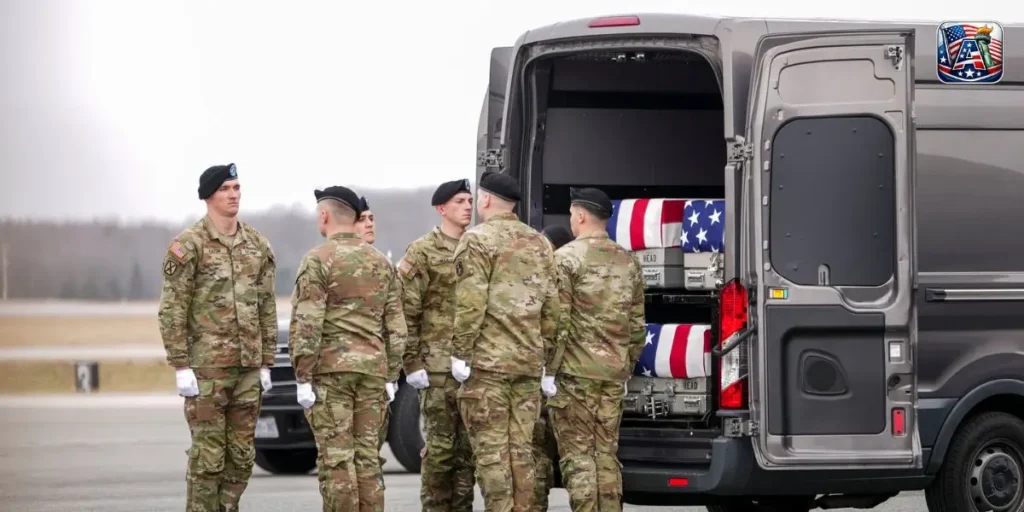
Government officials and military leaders have recognized the sacrifices of the fallen soldiers. Army Secretary Daniel Driscoll said, “These men and women all bravely volunteered to defend our country, and their sacrifice will never be forgotten.” Defense Secretary Pete Hegseth praised the aircrew members as “American heroes.” Governors, mayors, and local officials across the U.S. have issued flags at half-staff, memorial statements, and public tributes, ensuring that the sacrifices of these soldiers are remembered and honored.
Broader Implications
The Iran war of 2026 has had far-reaching effects beyond the battlefield.
- Military: Increased troop deployments, operational readiness, and logistical challenges across multiple countries.
- Political: Intensified debates over U.S. foreign policy and military engagement.
- Social: Communities across the nation are mourning, supporting military families, and honoring the fallen.
- Global: Rising tensions in the Middle East increase the risk of regional escalation and economic instability, including fluctuations in energy markets.
Major Incidents, Casualties, and Units Involved in the 2026 Iran War
Sadly, six Army Reserve troops died in a drone assault in Kuwait on March 1. From March 1 to March 8, there was an attack on Prince Sultan Air Base in Saudi Arabia that hurt a lot of people and killed Sgt. Benjamin N. Pennington. Then, on March 12, a KC-135 refuelling jet crashed in Iraq, killing six people on board.
The battle has also harmed a lot of people, with more than 200 U.S. soldiers hurt in Kuwait, Iraq, and Saudi Arabia. These casualties include burns, shrapnel wounds, and catastrophic brain damage. This illustrates how much the war is still costing individuals and businesses.
The 103rd Sustainment Command of the Army Reserve, the 121st Air Refuelling Wing of the Ohio Air National Guard, and the 1st Space Battalion, 1st Space Brigade all took part in these activities. This illustrates how crucial both support and specialist forces are in today’s wars.
Conclusion
The deaths of 13 U.S. soldiers in the 2026 Iran war are a stark reminder of the human cost of conflict. Each soldier—whether a parent, student, or lifelong serviceman—gave everything in service to their country. Their sacrifices extend beyond the battlefield, affecting families, communities, and the nation.
As the war continues, remembering the lives and stories of these soldiers ensures that their bravery and service are honored. These stories reflect courage, dedication, and the profound realities of modern warfare, highlighting both the personal and operational stakes of U.S. military engagement abroad.
FAQs
How many American soldiers have died in the war with Iran in 2026?
As of March 15, 2026, it has been confirmed that thirteen American soldiers have died in the fighting in Saudi Arabia, Iraq, and Kuwait.
That were the American soldiers that died in the conflict with Iran?
Some of the deceased include Sgt. Declan J. Coady, a college student from Iowa; Sgt. Nicole M. Amor, a mother of two from Minnesota; and six aircrew members of a KC-135 aeroplane that crashed in Iraq.
What event caused the most deaths?
The drone strike in Kuwait on March 1, the raid on Prince Sultan Air Base from March 1 to 8, and the crash of a KC-135 refuelling plane in Iraq on March 12 are all highly important occurrences.
What military units were involved in the events?
The 1st Space Battalion, the 1st Space Brigade, the 121st Air Refuelling Wing (Ohio Air National Guard), and the 103rd Sustainment Command (Army Reserve) were some of the most notable groups that took part.
How many American soldiers have been injured in the war?
More than 200 American soldiers have been hurt in Iraq, Kuwait, and Saudi Arabia. They have injuries that range from brain damage to burns and shrapnel wounds.
What does it signify that the KC-135 crashed?
The KC-135 catastrophe killed six aircrew men who were doing important aerial refuelling work. This shows how dangerous it is for support workers to be in a combat zone right now.
What have the families and communities of the soldiers who perished done to honour them?
Governors, mayors, and military officials have put up public monuments, memorials, and flags at half-staff to recognise their bravery and sacrifices.
What can we learn about how the military works now that these soldiers are dead?
The deaths show how horrible modern combat can be, even for individuals who are only helping out or handling logistics. This is especially true when many countries with advanced technology are fighting each other.